
Proof of Concept

A Software Proof of Concept (POC) is the first structured step after an idea. It turns your thinking into an initial plan.

Its main role is to confirm whether your idea is valid and worth pursuing. 

You would not build a house without deciding on the rooms, materials, and builder first. Yet in software, many teams rush into delivery without a clear plan and hope the missing pieces will sort themselves out later. 

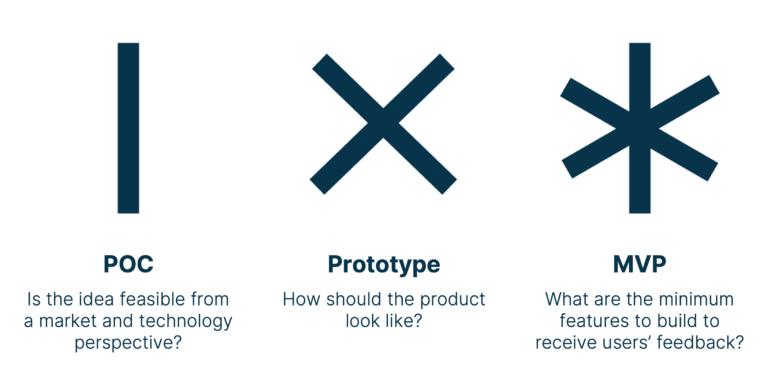
Differences between a POC, a Prototype and an MVP.

A POC can support a startup idea, a new product, or a fresh initiative inside an existing business. In all three cases, the same core principles generally apply. 

If you are still unsure which stage your project or business idea is in, start with our Introduction to a Software Development Plan.

Why a Proof of Concept matters 

  • You gain a clearer view of your project and concept 
  • If you need to present it to investors, they will expect tangible proof of the concept 
  • To gather and document feedback 
  • To save you money 

You gain a clearer view of your project and concept 

When you document your idea in a POC, you review the entire concept and uncover issues that would otherwise stay hidden. 

It also slows the thinking down in a good way, making it easier to define what actually needs to happen next.  

Show it to investors; They need proof 

Even when the investors are family or friends, you still need a clear and structured way to explain what you want to build. That is exactly what a POC provides. 

Feedback 

This is ultimately the most valuable benefit out of a POC. The feedback you will gather will help fine-tune your idea. It will also help you understand if you found a gem or if there’s nobody interested in it. 

Save you money 

A POC helps you save money in two ways:

  • It lets you verify if your idea is feasible before putting any significant amount of money into building an MVP. 
  • By setting the ground for the subsequent phases. It helps clarify the Scope so that you don’t spend money on the features and functionalities that aren’t required. 


 If you are not confident where to start, one of our specialists can help you in a free consultation meeting.


The 5 Key Questions you need to answer for a Remarkable POC
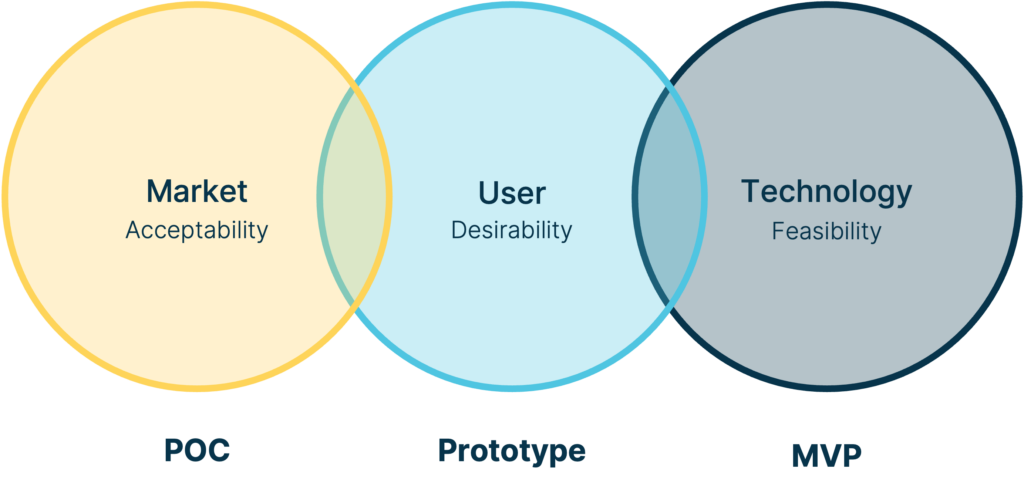
 
Similarities between a POC, a Prototype and an MVP.


Creating a POC is the very first step to any software endeavour and must answer the following: 
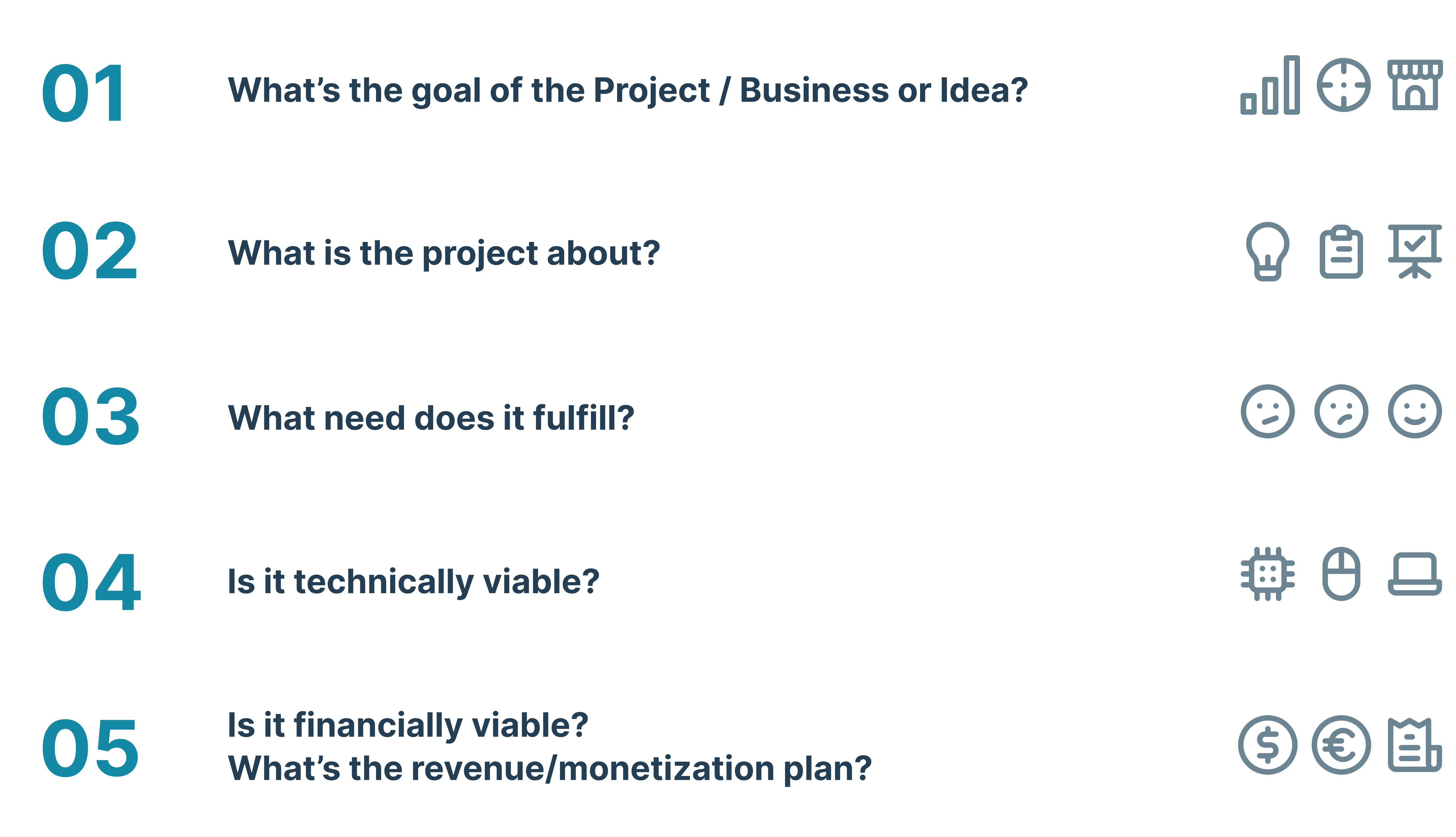
The 5 questions to answer in a POC. 

1. Goal 

Clearly Define the objective of what you are about to do. Are you aiming to be the next Unicorn? If so, how will you get there? Wouldn’t it make sense to start small and then build from it? 

2. About the Idea 

You must clearly state the concept behind your idea. When working on this part of your POC, you need to organize it from three different perspectives: 

  • Technically – How is it going to be technically created. Is it going to be you or are you partnering with someone to do it? 
  • Commercially – What’s your plan to seeling it and to whom? 
  • Intellectual Property – Will your idea generate IP ? does it infringes any patent? Are you aiming to register a brand? 

3. Fulfilling and Verifying a need 

This is probably the most crucial aspect to consider when writing your POC. According to CBInsights, this is the number one reason why new startups fail.  

Make sure your idea has a need on the market. An excellent indicator is if you already have customers for your idea.  

Try to answer the following: If you showed your idea or proof of concept to a potential customer, would you be able to get a contract signed before the product even existed?  

It would be best if you did a significant amount of research with your potential customers as well as the competition you’ll face. 

The more you research, the more confident you’ll feel about your project, and the more you’ll be able to convince others. 

Avoid technology for the sake of it just because you think AI, ML of Social, or any trending buzzword will sell. It doesn’t mean it’s needed. 

4. Technical Viability

Almost everything is possible given the correct sum of money. However, when evaluating how your product will see the day of light, you must correlate your vision correctly with the required amount of cash to execute it. Implementing sophisticated projects is expensive. 

It would be best if you answered these: 

  • Is it viable to create it?  
  • Wouldn’t you be easily outcompeted?  
  • Is your concept easily copied?  
  • Is there rocket science involved?  
  • Do you need to use innovative or immature technologies? 

Often, entrepreneurs want to build a particular product as cost-efficient as possible. However, realising what is possible with the given financial resources must always be on your mind. 

The Technical Viability is also about answering: What can I technically do with the resources I have? If I need to get a partner or hire someone to execute the project technically, is it reasonable what I’ll ask to be done? 

If you ask someone to build you a Facebook clone with a budget of $10.000, you would probably have some candidates bidding. Would you believe that it was technically feasible? 

5. Financial Viability 

Countless times, projects ran out of money and died because of bad planning. The POC is where you start to control it. 

Do your math on Expenses / Costs and Revenue. Use Praingol’s template to better map those.

Financial's template

Use Praingol’s Proof of concept template to evaluate the financial viability of your idea.

Take into account Development and Maintenance Costs, Marketing, Customer Service, Logistics, and People Management. Check how much it will cost you to do it yourself or what partners you need to find to share the cost and risk. 

A word about Marketing – How will you grab your customers? Do you have an idea of what your CoA (Cost of acquisition) will be? 

Although, you should not be creating a Marketing plan at this stage. 

It would be best if you start drafting it. It will give you deep insight into what your future costs could be. Ultimately, you can extract the most relevant findings to your POC. 

Steps to transform your idea into a Proof of Concept   

You have noticed a gap in the market or imagined a tool that might be helpful for other people. The first step is to write it down and idealize how the product and business model could be: 

  • Value proposition and what your product will add to the users.
  • Who can be the users 
  • What will be the channels through which the users will interact with the product.
  • What activities will be performed with your product.
  • What resources you might need to put the business in place
  • With who will you need to partner to get the resources defined.

To prove that your business is technically possible you should run a successful use case, at least one. 

Example 1 – Imagine that your idea is a food delivery app. Convince a restaurant to partner with you in a single delivery. Ask a friend to call the restaurant and ask for a meal delivered, pick your car and the meal in the pre agreed restaurant and complete the first order. This kind of experience will prove that the business is technically possible.

Example 2 – Imagine that you want to build a platform that aggregates all the real state properties from all the market providers. In that case you should try to run a basic web scrapper in one of the real estate agency website. The mentioned test would ensure that you are able to automate the data collection when it is time to scale. 

Step 3 – Demonstrate the market need for your product

In some situations, this step is not possible, but we advise all the entrepreneurs to not skeep it whenever possible. 

One common approach to demonstrate a need for a product is by creating and advertising a landing page even before having some functionalities running. Having a clickable landing page can give you insight on how much people you need to drive to your website to have a sale, how much money people are willing to pay for it and what functionalities are important for the users.   

In e-commerce businesses, a common practice is to advertise the products even before having them in stock or in production. This approach helps the business owners assess  how much they need to spend in advertising to sell a unit. By doing that, it is possible to clearly assess business financials before investing in product design, construction, etc.

In the end of the day you should have all the mentioned above reported in three documents:

  • Financial viability document 
  • Technical viability document 
  • Business model board (business model canvas or business plan)

Before moving forward to prototyping, the last phase is to show your POC to people who might give you opinions or contest your current assumptions. Despite not being mandatory, we advise you to have a Pitch Deck to smooth communication.

Feedback is king! Be prepared to listen to things that go against your beliefs and avoid friendly opinions. Learn how to receive feedback from friends and how to interpret the hidden messages in the book “The Mom Test” by Rob Fitzpatrick.

So, in essence, a POC is a Document  that: 

  • Demonstrates in practice your Product, Concept or Business 
  • Determines if an Idea can become real 
  • Tests and verifies the idea on paper 
  • Identifies possible technical and non-technical issues 

Do you feel ready to start your Proof of Concept? Schedule a Free Consultation Call with our experts. We will guide you about the next steps you should take to grow your business idea.


So, how to create a Proof of Concept? 

You should get used to how projects work. At its basic level, define the following: 

  • Estimate the Duration it will take to create the POC. 
  • Define the Scope. What will be in it? 
  • Define who will do it? You or you will pick a partner? 

Then break down into tasks of what you defined your Scope will be and assign tasks to your partners & coworkers for research. 

If you need more information, check out some Proof of Concept Templates to guide you in your process.